KNOWLEDGE ARCHITECTURE
500+ documents. One structured brain
Three years of market research — spanning brands, markets, and therapeutic areas — ingested, structured, and made queryable as a single coherent intelligence layer.
CASE STUDY
How a global dermatology company turned 500+ research documents into a live intelligence layer — and started making decisions grounded in data rather than memory.
THE SITUATION
This company does not have a research problem. It has a research access problem.
Over three years, their Insights & Analytics function had commissioned hundreds of market research studies across brands, markets, and therapeutic areas. Each one carefully designed, rigorously conducted, and professionally delivered.
Then filed.
In practice, the institutional knowledge locked inside those studies was only accessible to the people who remembered a specific study existed — and could find it. For everyone else, the research effectively did not exist.
The consequences were predictable. Decisions got made on gut feeling when the data to support them was sitting in a folder nobody opened. New research was commissioned to answer questions that existing studies had already addressed. And the insights team spent significant time fielding requests they could have answered in minutes — if the right document had been findable in seconds.
The problem was not the quality of the research. It was the gap between having knowledge and being able to use it.
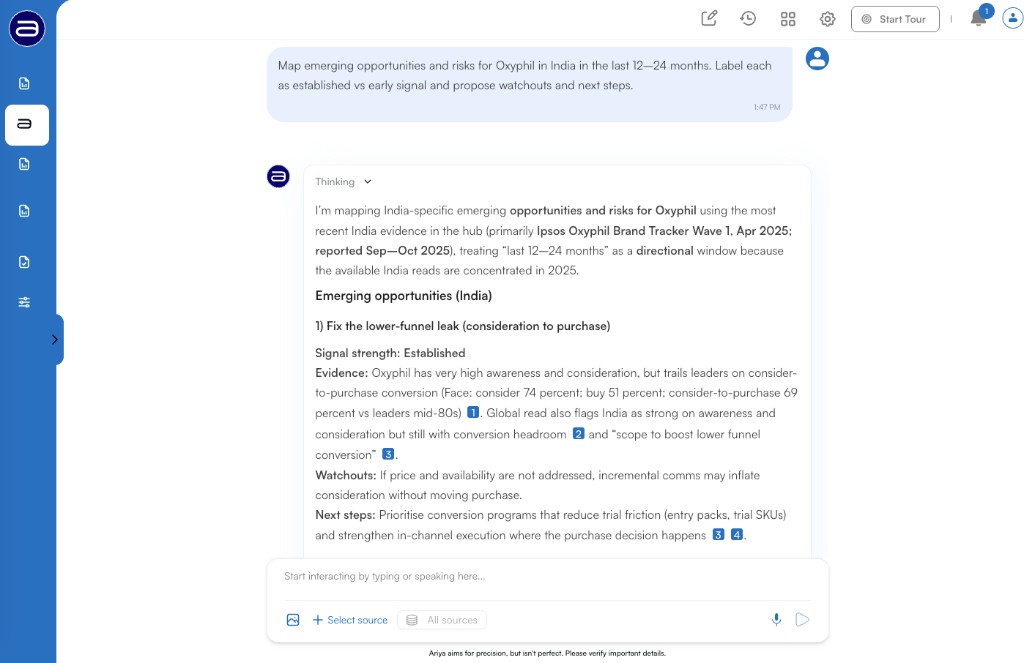
Ariya will help recommend a decision based on available internal data. (Screenshot data and names have been anonymized.)
WHAT WE BUILT
The engagement began with a systematic ingestion of every market research study commissioned over the previous three years — more than 500 documents spanning brands, markets, therapeutic areas, and time periods.
These were not simply uploaded and indexed. Each document was structured, tagged, and organised into a knowledge architecture that reflects how the insights team actually thinks — by brand, by market, by strategic question.
The result is Ariya: a decision intelligence interface that allows any member of the commercial or insights team to query the entire research base in natural language, surface relevant findings across multiple studies simultaneously, compare data points across markets and time periods, and receive strategy recommendations grounded explicitly in the evidence — with full traceability back to the source document.
The difference between this and a document search tool is the difference between finding a file and getting an answer. Ariya structures the intelligence behind the question, not just the documents that might contain a relevant sentence.
KNOWLEDGE ARCHITECTURE
Three years of market research — spanning brands, markets, and therapeutic areas — ingested, structured, and made queryable as a single coherent intelligence layer.
DECISION INTELLIGENCE
Users can query the entire research base conversationally, compare findings across studies, and receive strategy recommendations grounded in data — not in whoever happened to remember a relevant study existed.
RESEARCH EFFICIENCY
With existing research surfaced and accessible, the team can identify what prior studies already address before commissioning new ones — avoiding duplication and redirecting budget toward genuine knowledge gaps.
RESULTS
$250k saved — before anyone was looking for savings.
Within the first three months of deployment, two market research studies that had been scoped and were moving toward commissioning were cancelled. Not because the questions were wrong, but because Ariya surfaced existing research that answered them with sufficient depth and confidence to make new studies unnecessary.
Two studies. Combined value: 250,000 USD. Redirected to genuine knowledge gaps rather than spent on answers the organization already had.
That outcome was not engineered. It was the natural result of making existing research accessible at the moment a new research need was being scoped. When the team could query three years of studies in seconds, the first question became: do we already know this? In two cases in the first quarter alone, the answer was yes.
From a handful of people to hundreds — same research, whole organization.
Before Ariya, the institutional knowledge locked inside 500+ research documents was accessible to a small number of people — those who knew specific studies existed and could find them in a shared drive. In practice, most of the data stood still in a SharePoint folder nobody had time to navigate.
Today, hundreds of people across the organization access those same insights on a regular basis. The research budget spent over three years is finally working for the entire commercial organization — not just the few who knew where to look.
Decisions grounded in data, not in whoever remembered a relevant study existed.
The shift in how decisions get made is harder to quantify but consistently reported by the team. Questions that previously relied on institutional memory — or on gut feeling when memory failed — are now answered by querying the knowledge base directly. The evidence is in the room when the decision is made, not filed somewhere nobody opened since delivery.
Still early. Direction already clear.
This is an honest account of an early deployment. The metrics that will matter most — decision quality, research commissioning efficiency at scale, strategic alignment across markets — are still maturing. But the direction is clear, and it was clear within weeks.
Before a new market research study is approved, the team now asks a different first question.
Not: what do we need to know?
But: do we already know it?
That question did not exist before Ariya — not because nobody thought to ask it, but because there was no way to answer it quickly enough to matter. Searching manually across hundreds of studies to check whether existing research covered a new question was itself a research project.
Now it takes seconds. And in two cases within the first three months, it saved 250,000 USD.
Saved in the first three months — two research studies avoided because existing knowledge already had the answer
Increase in research accessibility — from a handful of people who knew where to look, to hundreds accessing insights regularly
Research documents now queryable in seconds — three years of institutional knowledge, finally working for the whole organization
Within three months we had avoided two research studies we did not need to run. The data to answer those questions was already there — we just could not find it before. That is 250,000 USD that went toward something we actually did not know.
Head of Insights & Analytics,
Global Dermatology Company
ARIYA CAPABILITIES USED IN THIS ENGAGEMENT
See how Ariya works on your own knowledge base — in 30 minutes, no slides.